Milan Transport Guide

Key Takeaway: A single Milan Metro ticket costs €2.20, but the €13.00 3-day ATM pass offers the best value for city explorers. High-speed rail connects Milan to the rest of the country in record time, hitting Rome in just 2 hours and 59 minutes. Secure your intercity seats early and check latest prices on italyrails.com to lock in the cheapest 2026 fares.
Sunlight slices through the massive glass canopy of Milano Centrale. It hits the polished marble floors, illuminating a hectic daily dance of commuters, tourists, and espresso-fueled locals. To navigate this city efficiently, you need a firm grasp of Milan public transport. I have spent countless hours dragging heavy luggage across these very platforms and riding the extensive metro network. So I know exactly what works, what costs too much, and what simply wastes your valuable vacation time.
Whether you are trying to reach the Duomo before the crowds or catch a high-speed train to Florence, mastering the local transit system is your key to a stress-free trip.
Quick Overview: Milan Public Transport at a Glance
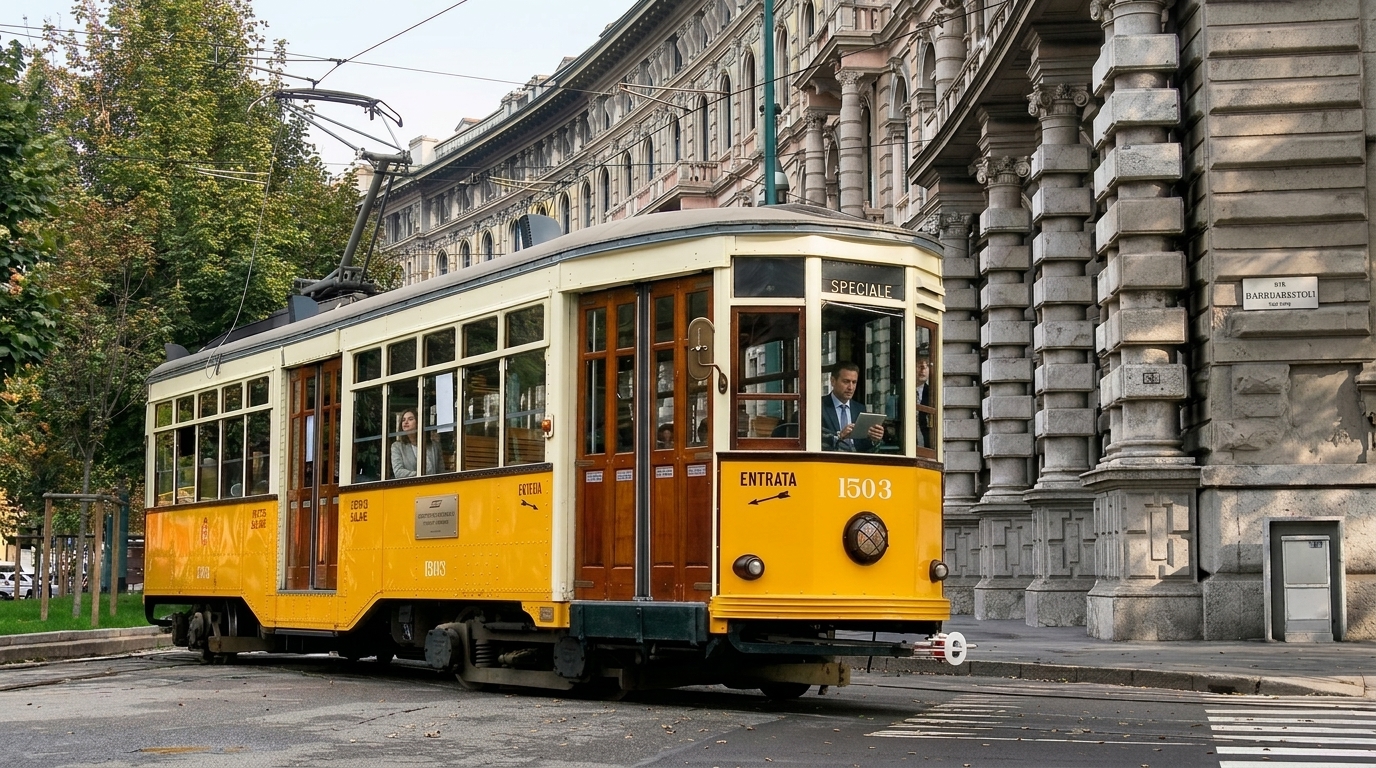
The system looks complex at first glance, with its mix of underground trains, historic trams, and suburban rail lines. But the underlying grid of Milan public transport is incredibly logical once you learn the basic rules.
- Metro (Subway): Five color-coded lines (M1 to M5) operate from 5:30 AM to 12:30 AM. The newer M4 and M5 lines are fully automated and driverless.
- Trams: 17 urban lines run above ground, featuring both modern air-conditioned cars and historic 1920s wooden carriages.
- Buses & Trolleybuses: Over 80 routes cover the gaps between Metro stations and serve the outer suburbs, including a robust night network.
- Suburban Railway (Trenord): The 'S' lines connect central Milan to the greater metropolitan area and neighboring towns.
- Payment: Tap-to-pay is active across the entire ATM network, capping your daily spend automatically so you never overpay.
Arriving by Air: Malpensa, Linate, and Bergamo

Flying into northern Italy means choosing between three very different airports. Each requires a distinct strategy to reach the city center without overpaying.
Linate (LIN) is practically inside the city limits. The new M4 (Blue Line) subway whisks you from the terminal to San Babila in just 12 minutes for €2.20. It is beautifully efficient and integrates seamlessly with the rest of the Milan public transport grid.
Malpensa (MXP), however, sits 50 kilometers northwest of the Duomo. You have two main choices here: the train or the bus. The Malpensa Express is the most reliable airport transfer, taking exactly 51 minutes to reach Milano Centrale for €13. Traffic on the A8 highway frequently delays the cheaper €10 coach buses, making the train the superior option. Book your Malpensa Express tickets online to skip the station queues.
Bergamo Orio al Serio (BGY) primarily serves budget airlines like Ryanair. There is no direct rail link yet. You must take a 50-minute bus ride to Milano Centrale, which costs €10 one-way.
| Airport | Transport Mode | Duration | Cost (One-Way) | Book Online |
|---|---|---|---|---|
| Linate (LIN) | M4 Metro | 12 mins | €2.20 | Buy at station |
| Malpensa (MXP) | Malpensa Express Train | 51 mins | €13.00 | Book train tickets online |
| Malpensa (MXP) | Terravision Bus | 60-70 mins | €10.00 | Buy at terminal |
| Bergamo (BGY) | Orio Shuttle Bus | 50-60 mins | €10.00 | Buy at terminal |
When you land at Malpensa, skip the taxi line entirely. A flat-rate cab to the city center costs a painful €110 in 2026. You are much better off taking the train and spending that saved cash on a phenomenal saffron risotto. Book at italyrails.com to have your Malpensa Express QR code ready before you even clear customs.
Navigating the City: The Milan Metro and Trams
Milan's public transit network is managed by ATM (Azienda Trasporti Milanesi). It is punctual, clean, and surprisingly affordable compared to London or Paris. Using Milan public transport is the fastest way to hop between the Last Supper, the Sforza Castle, and the Navigli district.
The Metro is your primary weapon for crossing the city quickly. The M1 (Red) and M3 (Yellow) lines intersect at the Duomo, forming the main arteries of tourist travel. Tap your credit card at the orange turnstiles. The system tracks your rides and caps your daily fare, ensuring you never pay more than necessary. Contactless payment at the Metro turnstiles caps your daily spending at €7.60 automatically in 2026.
Trams serve a different purpose. They are slower than the subway, but they offer a fantastic way to see the architecture. Ride the historic Line 1. Its antique wooden benches and warm yellow lighting provide an incredibly atmospheric journey past La Scala and Sempione Park.
| Ticket Type | Validity | 2026 Price | Best For... |
|---|---|---|---|
| Single Ticket | 90 minutes | €2.20 | Quick, one-off trips |
| 24-Hour Pass | 24 hrs from validation | €7.60 | Heavy sightseeing days |
| 3-Day Pass | 72 hrs from validation | €13.00 | Weekend city breaks |
| 10-Ticket Carnet | 10 separate 90-min rides | €19.50 | Couples sharing a digital pass |
Remember that standard tickets cover zones Mi1 to Mi3. This includes almost everything a visitor wants to see, plus the Fiera Milano exhibition center. If you plan to travel further afield, always check the zone map provided by ATM Milano.
Night Transit, Luggage, and Accessibility
Milan public transport doesn't sleep when the metro closes. After 12:30 AM, the night network takes over. The NM1, NM2, and NM3 buses follow the exact routes of the red, green, and yellow subway lines. They run every 30 minutes throughout the night, ensuring you can always get back to your hotel after a late dinner in Brera.
If you are traveling with heavy bags, you will be pleased to know that luggage is generally allowed on the metro and trams free of charge, provided it does not block the aisles. However, avoid taking large suitcases on the historic trams during rush hour (8:00 AM - 9:30 AM), as the narrow wooden doors make boarding extremely difficult.
Accessibility varies across the network. The newer M4 and M5 lines, along with the M3, are fully equipped with elevators and tactile paving. The older M1 and M2 lines are currently being upgraded, but some stations still rely heavily on stairs. Always check the ATM app for real-time elevator status before planning a wheelchair-accessible route.
Milano Centrale: The Hub of Italian Rail

If you want to explore the rest of Italy, Milano Centrale is your launchpad. The sheer scale of its fascist-era architecture makes you feel like an extra in a 1930s film set. It connects seamlessly with the local Milan public transport grid via the M2 and M3 metro lines.
Two companies dominate the high-speed rail tracks: Trenitalia (the state operator) and Italo (a private competitor). Both run trains that hit 300 km/h. Trenitalia's Frecciarossa trains feature four classes of service, while Italo offers a slightly sleeker, all-leather interior across its distinct carriage types. High-speed Frecciarossa trains depart Milano Centrale for Rome every 30 minutes during peak morning hours.
You can reach Florence in 1 hour and 50 minutes. Venice takes exactly 2 hours and 27 minutes. If you are heading south to the capital, read our Milan to Rome Train: 3-Hour Guide [Prices & Comparison] to understand the seating classes. The journey is remarkably smooth. The seats recline deep enough for a proper nap, and the legroom puts most airlines to shame.
Booking late is a terrible idea. Walk-up fares for a high-speed train to Rome can exceed €100 at the station. Buy your tickets two months in advance, and you can snag seats for as low as €29. Check latest prices on italyrails.com to secure those early-bird discounts and guarantee your departure time.
6 Pro Tips for Surviving Milanese Transit
I have made every mistake possible on Italian trains and Milan public transport so you do not have to. Follow these rules to save your sanity and your euros.
- Use the exact same card to tap out. If you tap into the M4 Metro with your phone, you must tap out with your phone. Using the physical card at the exit will result in a maximum penalty fare.
- Validate paper regional tickets. If you buy a paper ticket for a Trenord regional train, stamp it in the green machines on the platform. High-speed electronic tickets do not require this. Book digital tickets to avoid this hassle entirely.
- Watch out for strike days (Sciopero). Transit strikes happen frequently in Italy, usually on Fridays. Always check local news before your trip.
- Understand the train numbers. Platform screens at Milano Centrale list the train number (e.g., FR 9535) rather than the final destination. Match the number on your italyrails.com ticket to the departure board.
- Read the complete network guide. If you plan to travel extensively across the country, review our Train Travel in Italy: 2026 Guide to Fares & Routes for detailed route maps.
- Avoid the Centrale taxi queue at 8 PM. It is notoriously long. Walk one block away from the station to Piazza Duca d'Aosta and order an Uber Black, or simply hop on the Metro.
Frequently Asked Questions
How much is a Metro ticket in Milan?
A single Milan Metro ticket costs €2.20 and is valid for 90 minutes of travel across the entire ATM network, including buses and trams.
What is the best way to get from Malpensa Airport to Milan?
The Malpensa Express is the most reliable transport option, costing €13 for a 51-minute journey directly to Milano Centrale or Cadorna station. You can book this transfer online in advance.
Does Milan public transport accept contactless payments?
Yes, Milan's ATM network supports tap-to-pay using contactless credit cards or digital wallets, automatically applying daily fare capping for the best value.
How long is the train from Milan to Rome?
High-speed trains connect Milan to Rome in as little as 2 hours and 59 minutes, with frequent departures throughout the day from Milano Centrale.
Is there a 3-day travel pass for Milan?
A 3-day ATM travel pass costs €13.00 and offers unlimited travel on all urban Milan public transport within the city limits for a 72-hour period.